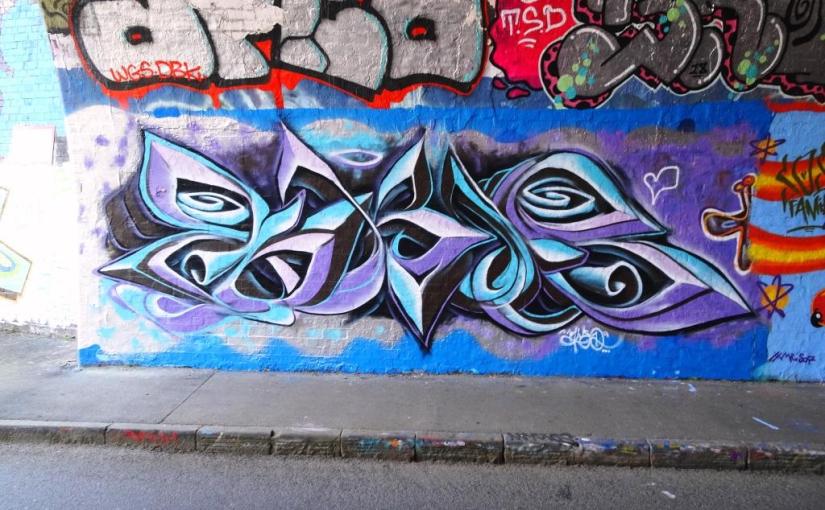
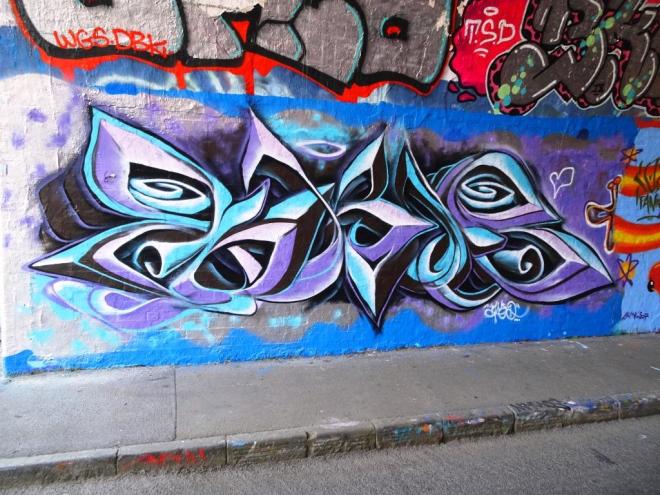
You wait for ages to see a piece by Mr Klue, and then two come along at once. I love the style that Mr Klue uses, both his colour selections which are often in these blues and purples and his abstract style.
Mr Klue, St Werburghs, Bristol, July 2018
I think that this piece is also a very clever bit of writing, although I might be reading too much into it. I think that I can make out the letters KLUE, but it might just be wishful thinking.
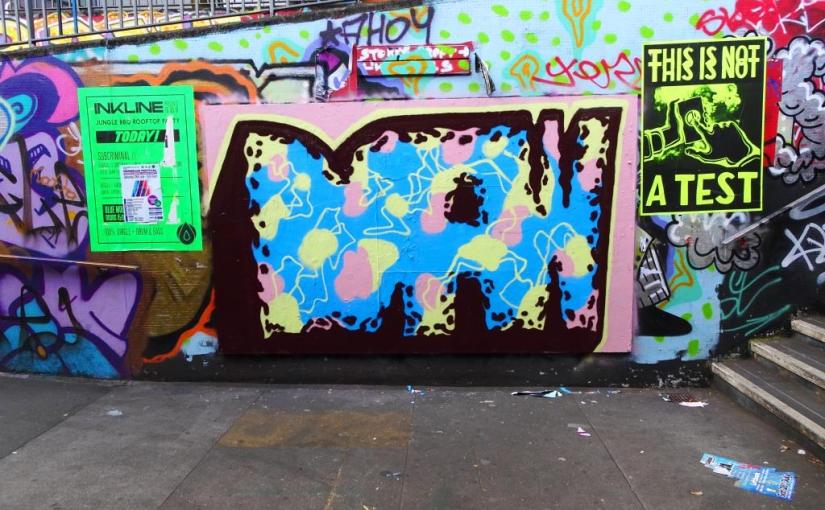
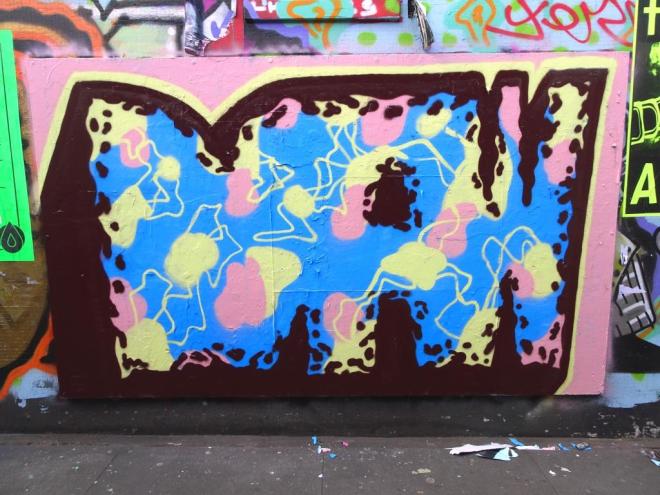
Run Z is a Bristol abstract artist that I have not yet had the fortune to run in to yet and one about whom I know very little. His pieces are very distinct, using bright colours and organic patterns that swirl across the wall.
RunZ, The Bearpit, Bristol, July 2018
We are lucky in Bristol to have several specialists in abstract street art like Run Z and I think it all adds to the overall complexion and variety of the Bristol street art scene. I’m on a mission to hunt down more of his work.
Tireless and irrepressible, words I am sure I have used to describe Mr Draws in the past. His habit must cost him an absolute fortune in paint. Until I had a go myself, I hadn’t realised how much paint one can get through to cover quite a small area of wall.
Mr Draws, The Bearpit, July 2018
This quick one in the Bearpit has an interesting ‘bleed’ from the shadow into the letters, giving it the effect of degrading in front of our eyes. More to come from Mr Draws, before he moves to Germany.
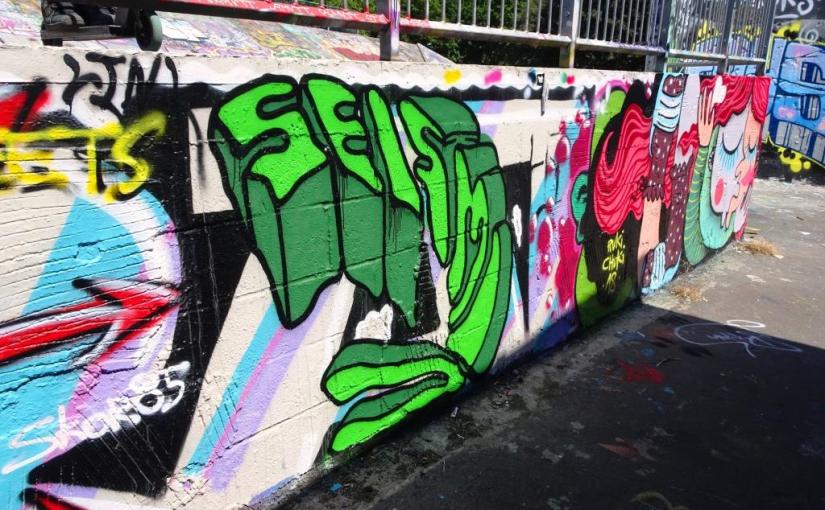
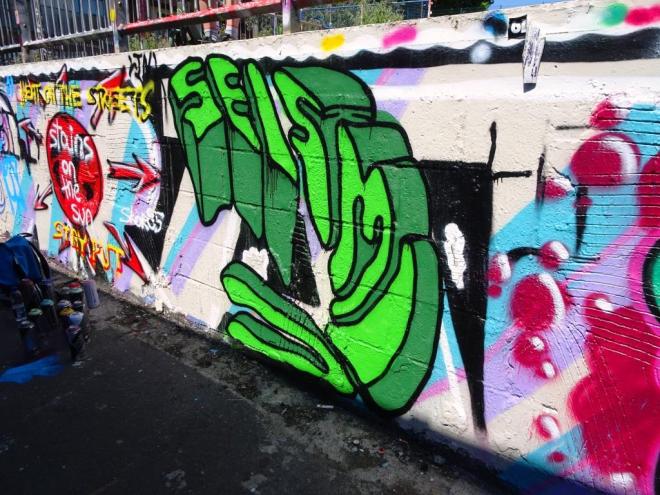
The unmistakable seismic tag of Jee See. This is just a quick one in Dean Lane skate park. I am interested in this tag, because he uses different 3d skadows for divverent letters, so the SEI shadow downwards, the SMI shadow to the right and the C shadows upwards, which makes for an interesting perspective. Helpful to me to in learning how to work these shadows.
Jee See, Dean Lane, Bristol, July 2018
I understand the Jee See used to be a teacher, so there is really nothing to stop me picking up a can and getting busy. I get inspiration from artists like Jee See who find spots around the city and practice their work.
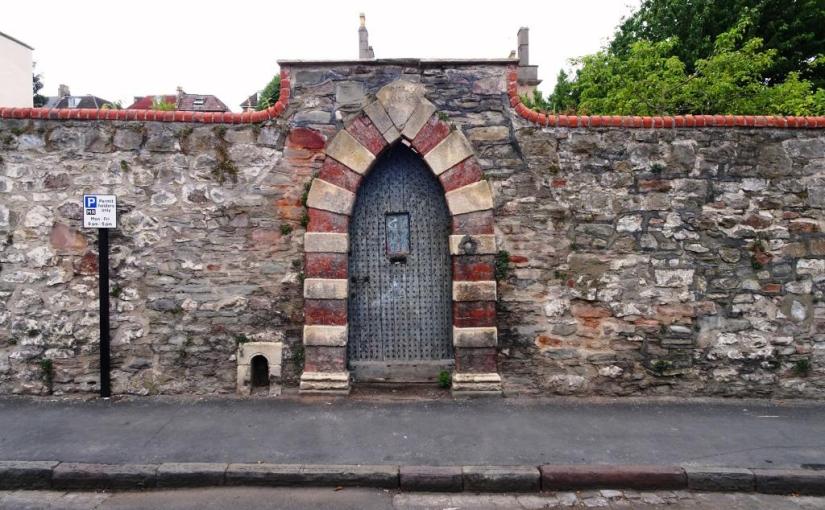
I saw this door yesterday, while on a short walkabout looking for (yes…predictably) street art. The door is situated at the bottom end of a walled garden belonging to a house called Field House – the words can just about be seen engraved into the keystone at the top of the arch. That was all I knew about the place, so I set to work…thank you Interweb.
Door, Montpelier, Bristol
The House, which is Grade II listed, was built in the early part of the 19th century, and when it was first built, there was not much in the way of other buildings in the immediate vacinity.
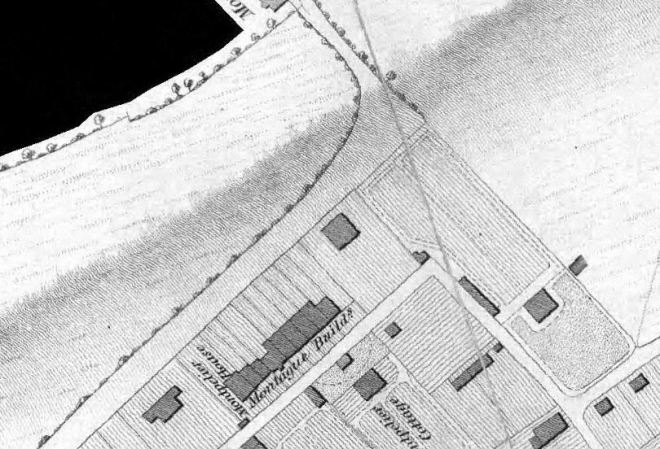
Field House, Montpelier 1828
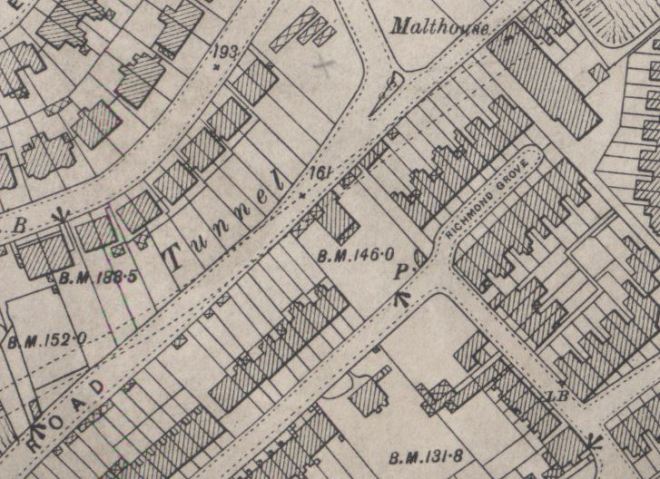
You can see Field House in the map above appearing as a square in the centre of the picture – the garden is still intact today.
Field House, Montpelier, 1855
Not an awful lot has changed by 1855, but the map is a little bit more detailed. There is a small outbuilding in the bottom corner of the garden.
Field House, Montpelier, 1880s
By the 1880s there is a major change and many new houses have appeared, especially to the north of Field House. Urbanisation, population growth and the impacts of the industrial revolution will all have contributed to the spread of housing in the city.
Field House, Montpelier, 1900s
By the 1900s the area had become swamped by the growth of the city, however, the walled garden has remained and is a small oasis and time capsule of how things were.
I took a peek through the door and the garden is no longer a grand garden with organised flowerbeds, but is laid out as a split level lawn…looking very yellow due to the lack of rain with one or two trees. The outbuilding is no longer there.
Great to understand a little more about what lies behind a door.
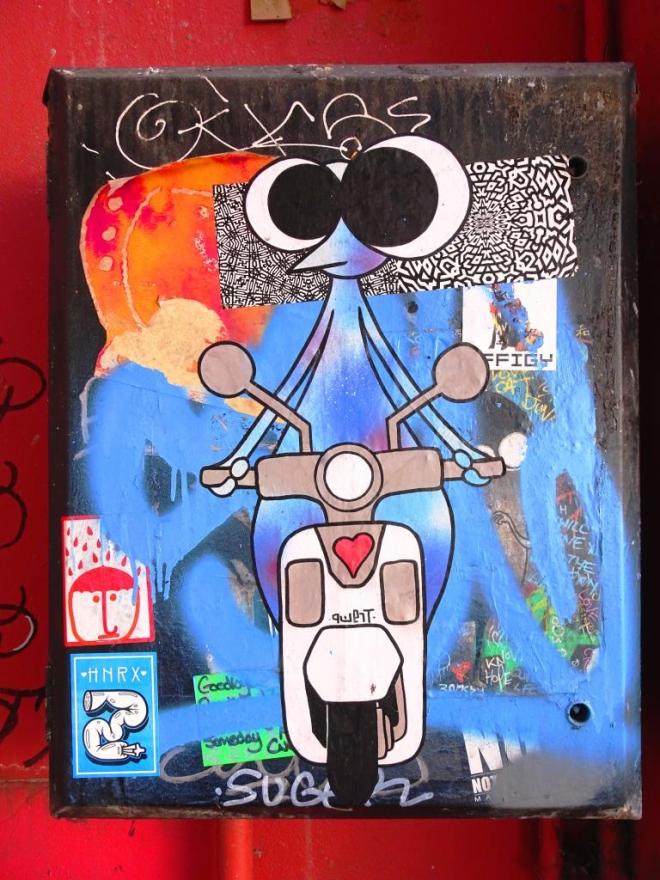
The great thing about visiting wheatpasters is that rarely do they come to town and leave only one paste up. Rather they tend to leave a trail of little treasures dotted about the place, and that is exactly what qWeRT did on a recent trip to Bristol.
qWeRT, North Street, Bristol, July 2018
I particularly like this one of our googly eyed hero riding a scooter. The placement is in a little alcove that has been a honeypot for small stencils and wheatpastes, but is in its last throws as a street art spot due to the completion of a new development adjoining it. This is one of the things I am noticing about Bristol at the moment, it seems that there is a decreasing number of places where street artists can do their work. Gentrification is on the move and with it comes displacement. Of course, we all want a prosperous and attractice city, but beauty is in the eye of the beholder.
Splat! The more I see of Nevla’s work, the more I want to see. He is emerging as one of my favourite local artists and is becoming bolder with his pieces and his locations. Usually working in only two or three colours he creates these characters and sometimes introduces little philosophical comments to add depth to his work.
Nevla, Moon Street, Bristol, July 2018
I particularly like the writing (ALVEN – NEVLA – get it?), where he has given a double line accent in the shadow of his letters which really lifts them off the wall. Beautifully done. He has also used a vanishing point for his 3D work, similar to the way Elvs does. This is a wholly satisfying piece by Nevla…upwards and onwards.
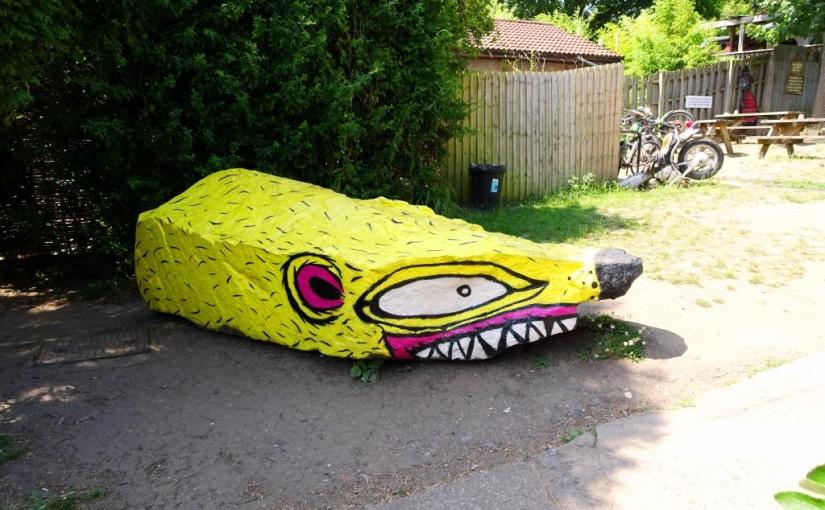
There are quite a few of these large rocks dotted around Bristol, I think originally strategically placed to stop people illegally parking on curbsides. Several of them have been brightened up by the brilliant artist Rowdy. Best known for his toothy crocodiles, this artist has a knack for turning the mundaine into something interesting.
Rowdy, St Werburghs farm, Bristol, July 2018
Seeing the world through a different lens is a skill. Helping others to see your visions is a gift, and one that Rowdy exploits with ease. This rat, I’m sure, is a favourite with the thousands of visitors to the city farm, young and old alike. I’ll see if I can dig out some more of his ‘rock works’.










 Natural adventures