A few days each year
queen ants emerge from their nests;
gull feeding frenzy.
by Scooj
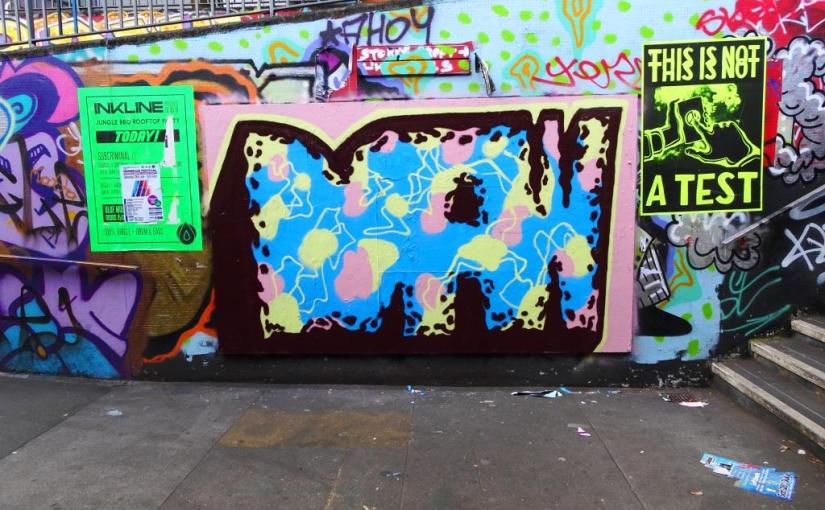
Tireless and irrepressible, words I am sure I have used to describe Mr Draws in the past. His habit must cost him an absolute fortune in paint. Until I had a go myself, I hadn’t realised how much paint one can get through to cover quite a small area of wall.
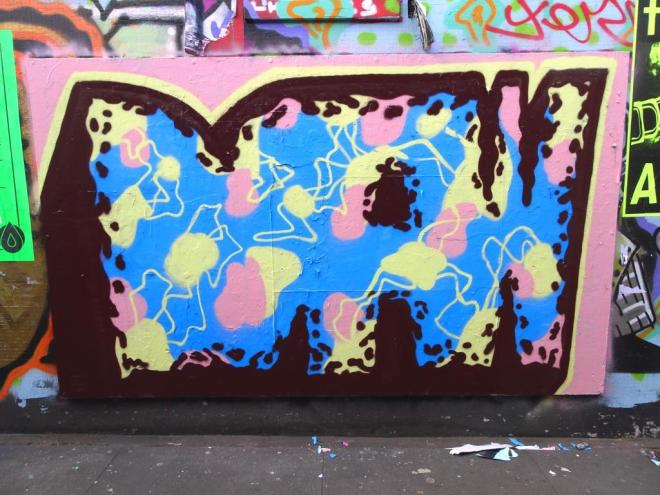
This quick one in the Bearpit has an interesting ‘bleed’ from the shadow into the letters, giving it the effect of degrading in front of our eyes. More to come from Mr Draws, before he moves to Germany.
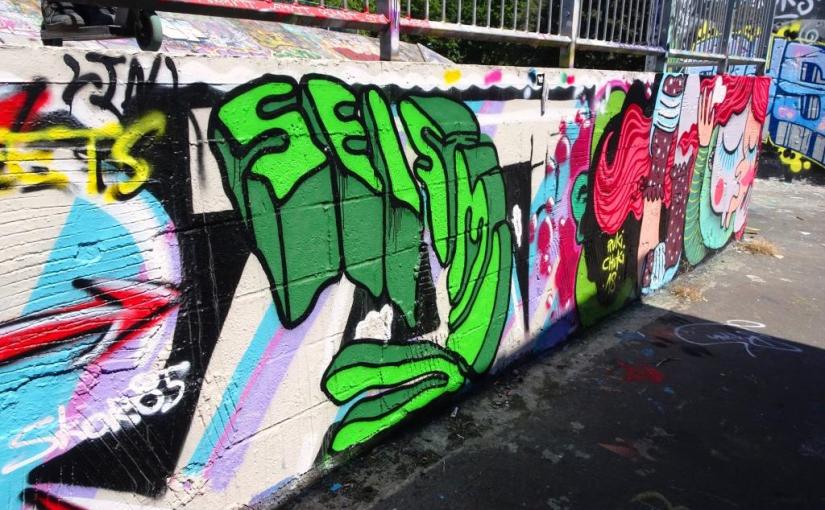
The unmistakable seismic tag of Jee See. This is just a quick one in Dean Lane skate park. I am interested in this tag, because he uses different 3d skadows for divverent letters, so the SEI shadow downwards, the SMI shadow to the right and the C shadows upwards, which makes for an interesting perspective. Helpful to me to in learning how to work these shadows.
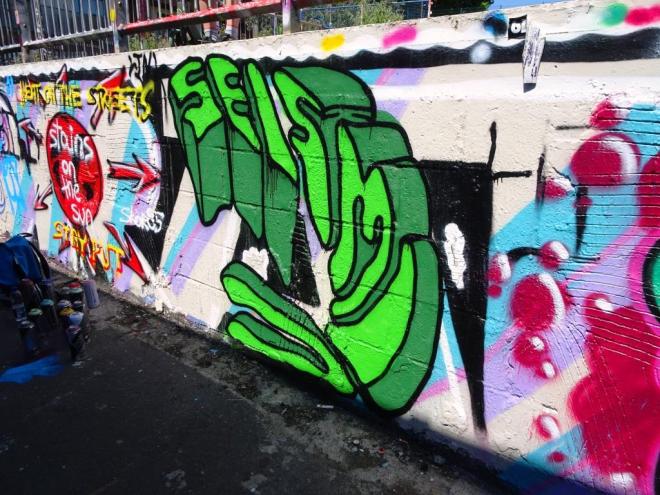
I understand the Jee See used to be a teacher, so there is really nothing to stop me picking up a can and getting busy. I get inspiration from artists like Jee See who find spots around the city and practice their work.
Door 40

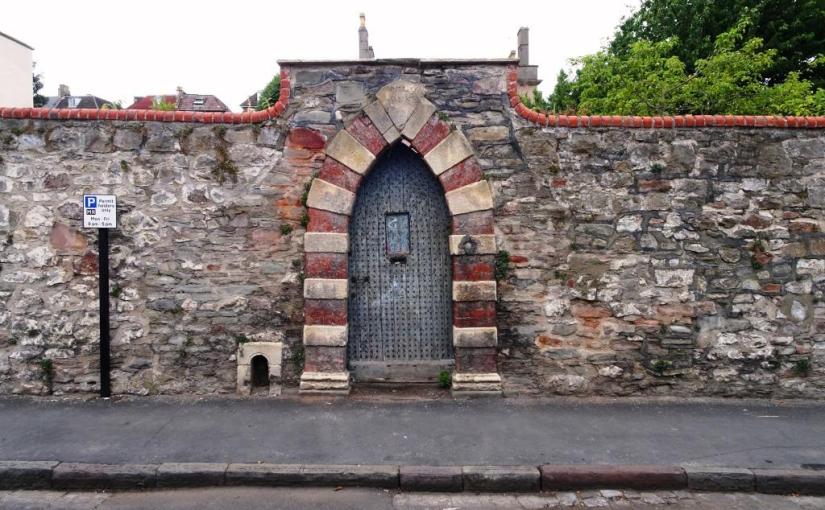
I saw this door yesterday, while on a short walkabout looking for (yes…predictably) street art. The door is situated at the bottom end of a walled garden belonging to a house called Field House – the words can just about be seen engraved into the keystone at the top of the arch. That was all I knew about the place, so I set to work…thank you Interweb.

The House, which is Grade II listed, was built in the early part of the 19th century, and when it was first built, there was not much in the way of other buildings in the immediate vacinity.
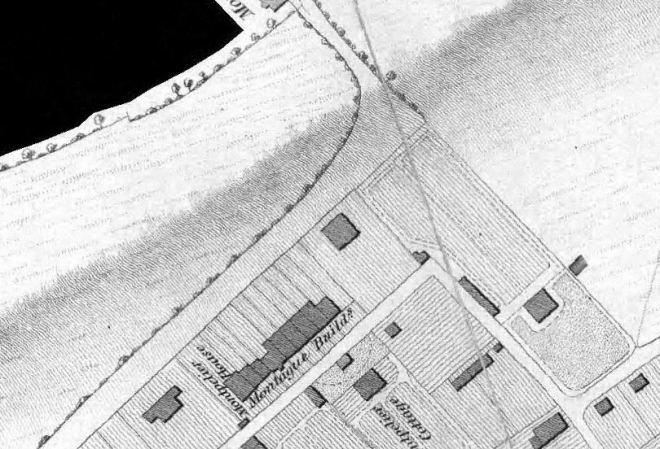
You can see Field House in the map above appearing as a square in the centre of the picture – the garden is still intact today.

Not an awful lot has changed by 1855, but the map is a little bit more detailed. There is a small outbuilding in the bottom corner of the garden.

By the 1880s there is a major change and many new houses have appeared, especially to the north of Field House. Urbanisation, population growth and the impacts of the industrial revolution will all have contributed to the spread of housing in the city.
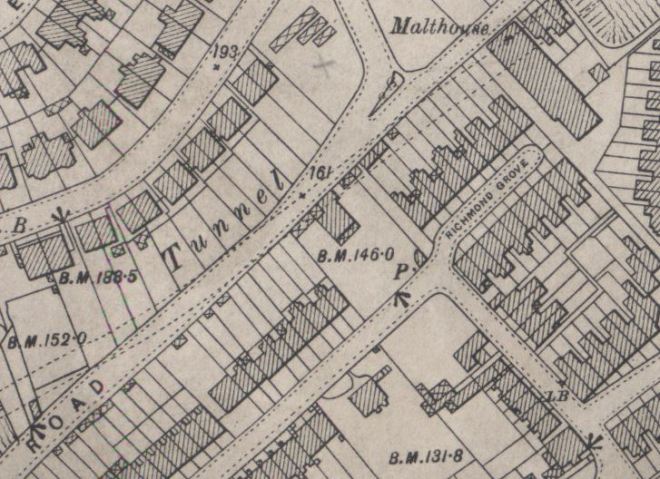
By the 1900s the area had become swamped by the growth of the city, however, the walled garden has remained and is a small oasis and time capsule of how things were.
I took a peek through the door and the garden is no longer a grand garden with organised flowerbeds, but is laid out as a split level lawn…looking very yellow due to the lack of rain with one or two trees. The outbuilding is no longer there.
Great to understand a little more about what lies behind a door.
by Scooj
More doors at: Thursday Doors – Norm 2.0
The great thing about visiting wheatpasters is that rarely do they come to town and leave only one paste up. Rather they tend to leave a trail of little treasures dotted about the place, and that is exactly what qWeRT did on a recent trip to Bristol.
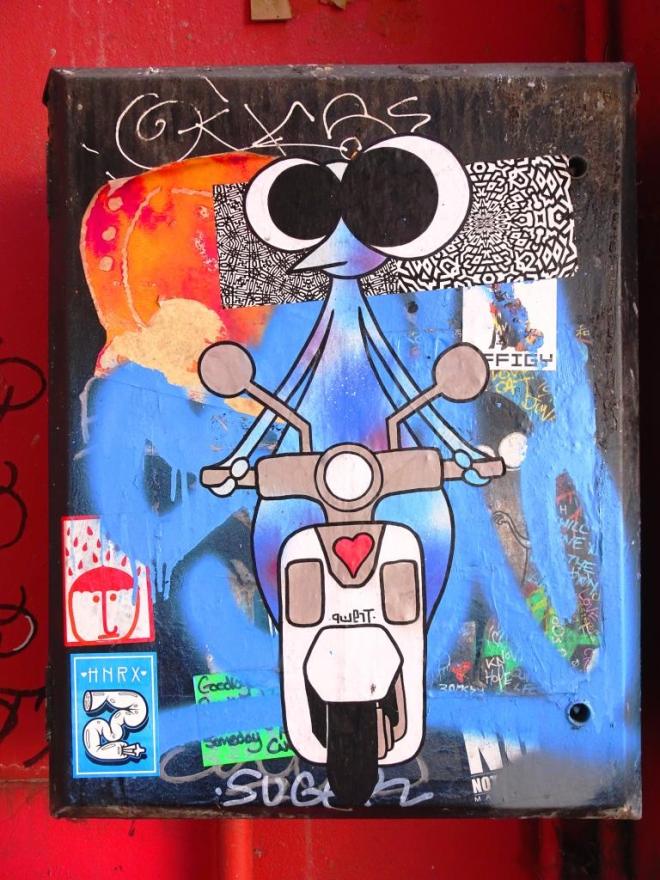
I particularly like this one of our googly eyed hero riding a scooter. The placement is in a little alcove that has been a honeypot for small stencils and wheatpastes, but is in its last throws as a street art spot due to the completion of a new development adjoining it. This is one of the things I am noticing about Bristol at the moment, it seems that there is a decreasing number of places where street artists can do their work. Gentrification is on the move and with it comes displacement. Of course, we all want a prosperous and attractice city, but beauty is in the eye of the beholder.
Splat! The more I see of Nevla’s work, the more I want to see. He is emerging as one of my favourite local artists and is becoming bolder with his pieces and his locations. Usually working in only two or three colours he creates these characters and sometimes introduces little philosophical comments to add depth to his work.

I particularly like the writing (ALVEN – NEVLA – get it?), where he has given a double line accent in the shadow of his letters which really lifts them off the wall. Beautifully done. He has also used a vanishing point for his 3D work, similar to the way Elvs does. This is a wholly satisfying piece by Nevla…upwards and onwards.

In the night
they came with their swords
and stole dreams
in the night
buccaneers of my tired mind
left me with nothing.
by Scooj
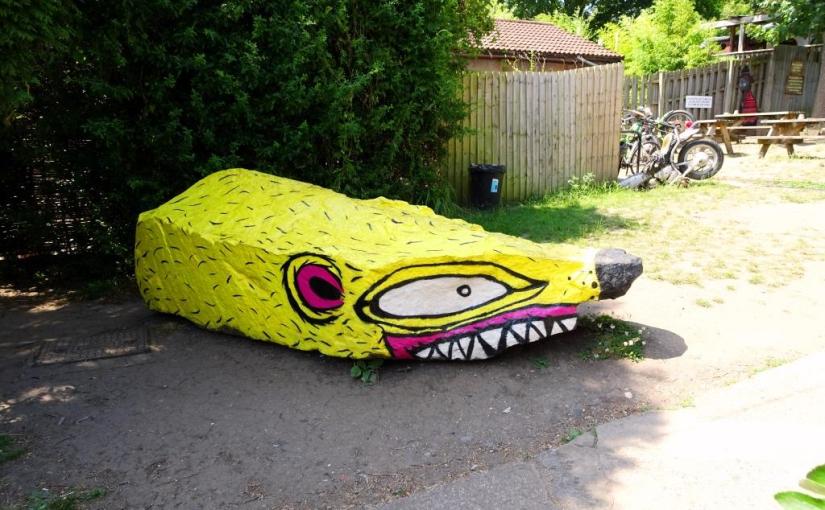
There are quite a few of these large rocks dotted around Bristol, I think originally strategically placed to stop people illegally parking on curbsides. Several of them have been brightened up by the brilliant artist Rowdy. Best known for his toothy crocodiles, this artist has a knack for turning the mundaine into something interesting.

Seeing the world through a different lens is a skill. Helping others to see your visions is a gift, and one that Rowdy exploits with ease. This rat, I’m sure, is a favourite with the thousands of visitors to the city farm, young and old alike. I’ll see if I can dig out some more of his ‘rock works’.
So here he is again, same spot different rabbit. Not long ago I posted a lovely orange bunny by Nevergiveup in this exact gateway. He is such a busy artist that when he runs out of walls, he simply goes over one he has done before, buffing over his own work.

I have said it before on this blog that I love these creatures that he populates the city with, and at risk of becoming a bit repetative, I will continue to post them… because I can.

Well now, here is another fabulous stencil by Stephen Quick, and due to its location in a car park is almost impossible to photograph, so I will rebrand these images as ‘arty’ on account of the fine reflections on the shiny black bonnet of the annoying car parked in front of the piece.

Once again Stephen Quick spoils us with an image of an iconic figure in the shape of Totoro. The piece is called ‘I bet you’re Totoro and is a direct reference to a massive manga film I have never seen, made in 1988, ‘My Neighbour Totoro‘. Exposing my ignorance even further, I am not sure who the lady in the picture is, but I am sure she is probably famous. I am not very good with Iconic references and usually do really badly on those online quizzes you see from time to time. Now ask me something about natural history and I am onto a winner.

This is a really fabulous and intricate stencil and I know that Stephen spends many hours preparing for these pieces. Maybe one day he could give me some basic tips for my ambitions one day to join the ranks of Bristol street artists.